

Designed and built in Italy, with an engineering approach focused on signal purity.
A DAC with no unnecessary or questionable features: extremely simple to use, yet capable of delivering a performance you might not expect.
The sole purpose of a DAC is to faithfully reproduce the digital signal it receives, converting it into analog form — not to impress with a long list of features.
It is designed to make an impression where it matters: in the listening experience.
It represents the MicroSound philosophy at its best: the pursuit of maximum transparency and fidelity to the original signal, without adding or removing anything from the music.
The CDA1 offers a rock-solid and authoritative low end, paired with a mid-high range that is rich in detail, texture and clarity — while never becoming fatiguing over long listening sessions.
It embodies the MicroSound philosophy: maximum transparency and faithfulness to the original signal, without adding coloration or removing nuance.
This DAC succeeds in revealing fine details and reconstructing a convincing soundstage : qualities that many D/A converters, even those costing considerably more, often fail to deliver, while preserving ease, naturalness and long-term listening pleasure.
The integrity of micro-details is preserved by avoiding unwanted modulation at the conversion node, a key factor in maintaining the sound’s natural character.
The importance of the source is fundamental: no electronics placed downstream can improve the sound beyond what the source delivers, nor can they add detail, clarity or soundstage that were not already present.
It is essential to have a high-quality source that can remain a reference for years to come.
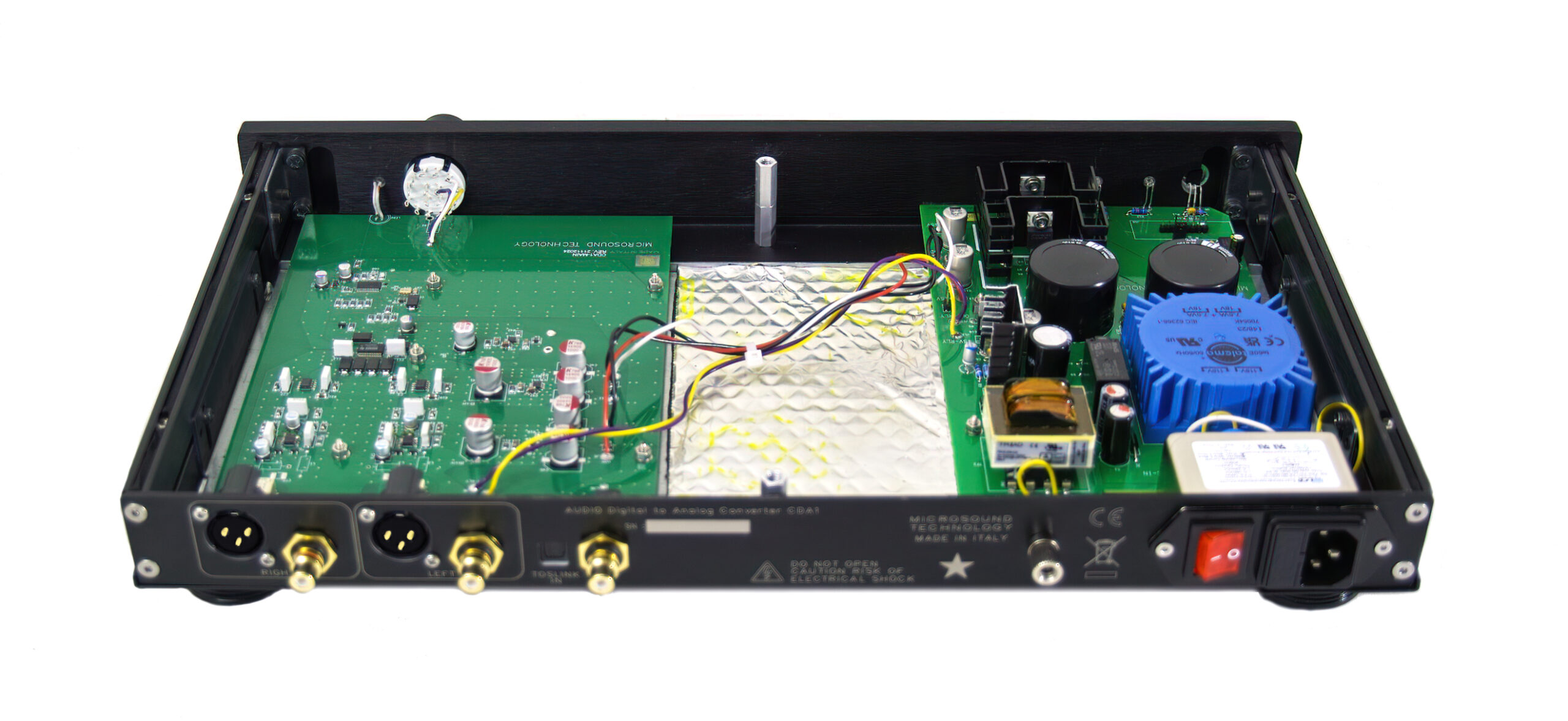
Constructed in an aluminium and steel chassis, featuring a 10 mm solid aluminium front panel.
Fully linear power supply with two-stage series regulation.
Constructed using only high-quality components.
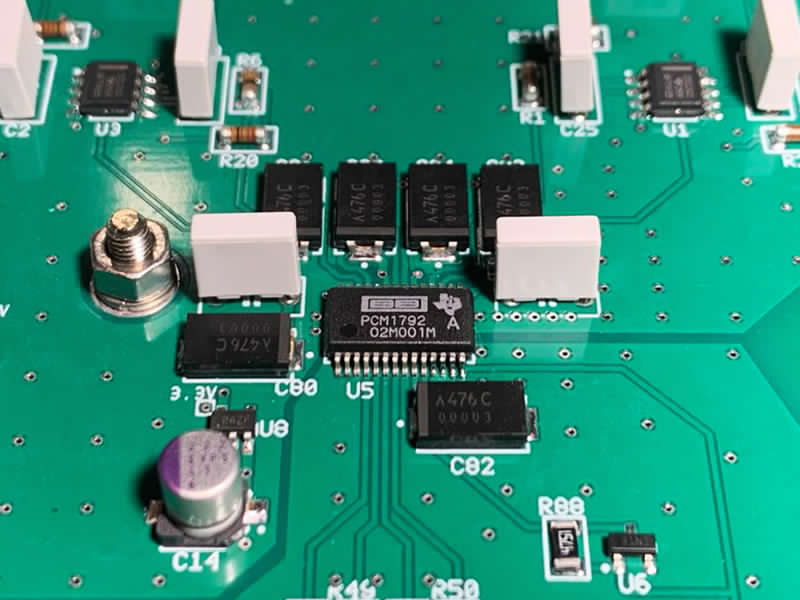
Based on the Burr-Brown PCM1792A, the state-of-the-art of Burr-Brown D/A converter design.
All electrolytic capacitors are polymer or polymer-tantalum types, except for four in the power supply where Cornell Dubilier and Panasonic FR capacitors are used.
Ultra-low-noise Analog Devices linear LDO regulators: 2 × LT3042 and LT3093.
TCXO oscillator with –135 dBc phase jitter and ±2.5 ppm frequency stability.
I/V conversion implemented using:
- Vishay thin-film MELF resistors, 0.1% tolerance and 15 ppm/°C temperature stability
– hand-soldered polypropylene (PP) capacitors to minimize thermal stress
- top-grade Burr-Brown audio operational amplifiers
4-layer PCB with separated ground planes.
Mute function active during power-on and power-off.
Standby function accessible from the front panel and remote control.
Characteristics
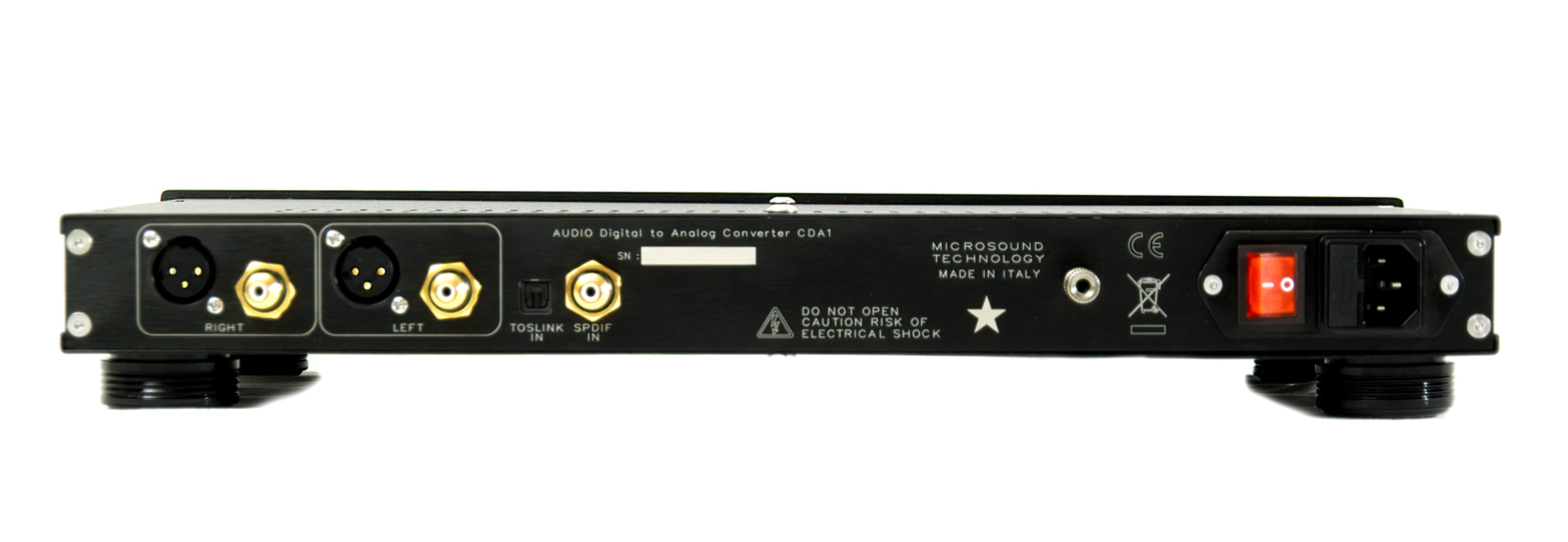
Inputs: SPDIF RCA with galvanic isolation and optical TosLink, manually selectable from the front panel (no USB, see footnote 1). 1 ).
Outputs: RCA Left and Right, XLR Left and Right.
Total Harmonic Distortion (THD) at 1 kHz, 0 dBV output: 0.0007%, SNR > 100 dB
Total Harmonic Distortion (THD) at 1 kHz, –60 dBV output: 0.021%
D/A conversion up to 24-bit / 192 kHz (see footnote 2). 2 ).
Specifications are subject to change without notice.
Featured in AudioReview, issue 476 (June 2025)
(nota : a differenza dell’esemplare oggetto della prova, gli apparecchi attualmente prodotti generano un segnale in fase diretta, non invertita come nelle misure della rivista)
List price: € 2,250 including VAT
If USB connectivity is needed, we recommend using a high-quality USB-to-SPDIF interface.
For example, an SMSL PO100 Pro or a higher-grade model.
- Why no USB interface?
The USB interface in a DAC is an accessory stage: it is responsible for format conversion before the D/A process takes place.
These formats and protocols evolve over time and may require firmware updates or hardware changes.
An SPDIF-based DAC, on the other hand, remains functionally stable and always usable, regardless of protocol changes.
Sono diffuse ormai da molti anni interfacce esterne USB > SPDIF per ogni livello di prestazioni richieste, riteniamo che sia meglio lasciare all’utilizzatore la scelta dell’interfaccia e la sua eventuale sostituzione nel tempo, se necessaria.
The CDA1 is designed to be a truly long-lasting component.
As noted above, we recommend an interface of around €70 which performs this task exceptionally well. Just a few years ago, achieving such performance at that cost would have been unthinkable.
For the same reason, we do not include Bluetooth or other auxiliary digital interfaces.
The trend of adding multiple input formats and protocols in DACs is often used to justify a higher retail price by filling the product with additional electronics that do not contribute to sound quality.
↩︎ - Why “only” 24-bit resolution?
A true 24-bit resolution is already beyond the practical limits of current electronics. Even if the electronic circuitry were capable of exceeding the threshold imposed by thermal noise, our hearing would still not be able to perceive such minute variations.
This makes the idea of a 32-bit DAC largely unnecessary, especially considering that — in real-world conditions — even very high-quality converters resolve effectively around twenty bits at best.
A 24-bit DAC would require an SNR of approximately 146 dB to fully express its theoretical resolution — a figure beyond the capabilities of current consumer electronics and beyond the limits of human hearing.
A 32-bit DAC would require an SNR of 194 dB, a value that is physically unrealistic: it exceeds both the current and foreseeable limits of electronic design, and has no relevance to audio reproduction or human perception.
It is important not to confuse 32-bit internal processing — which is meaningful in digital signal computation — with the effective resolution of a D/A converter. While 32-bit processing can be useful inside digital audio processors, there is no sense in expecting a DAC to resolve 32 bits.
See the this same reference on bit depth and the corresponding SNR requirements for more detail.
Additionally, this same reference explains the concept of ENOB (Effective Number of Bits), which describes the real resolution of a DAC within its noise floor. For example, one cannot benefit from a 24-bit DAC with a 120 dB SNR if the downstream amplification system has a signal-to-noise ratio of only 70 dB. The background noise of the subsequent electronics will mask the fine detail of the source, reducing the effective resolution to the ENOB of the entire chain.
↩︎